Marine Science BSc (Hons)
 Course code: F710
 Study mode: You study most days of the week and complete all course units /modules in the standard time., You take fewer course units/modules per week compared to full time.
 Course type: BSc (Hons)
 International: Available to study on-campus
 Study at: SAMS
 Start in: September
 Learning mode: You attend classes in person at your local campus or learning centre., You access classes and/or materials digitally., You will come together with other students for short, intensive periods (e.g., a day, week or longer).
 Duration: Full time: 4 years; Part time: 8 years
 How: You attend classes at scheduled times, shown on your timetable.
What is special about this course?
Are you passionate about our seas and oceans? Can you imagine studying at a beachfront campus, with an enormous wealth of marine and coastal environments right outside your door?
Dive into an incredible living research environment, with internationally-renowned, state-of-the-art marine laboratory facilities, at the Scottish Association for Marine Science (SAMS) on Scotland‘s west coast. Enjoy first-hand interactions with marine science experts, collect samples and data on research vessels, in aquaria and on the seashore, and develop excellent laboratory skills.
Choose to study abroad in your third year at the University Centre in Svalbard (UNIS) in the Arctic Circle or Coastal Carolina, USA.
Explore the marine realm first hand and apply the latest technologies throughout your studies, with subjects such as oceanography, biogeochemical cycling, conservation, robotics, data analysis and instrumentation, polar seas, the marine carbon cycle, and much more.
A brilliant springboard to success in your future marine science career, exit with a BSc (Hons) Marine Science or choose to pursue pathways in Arctic Studies, Marine Biology, or Oceanography and Robotics.
If you'd be interested in pursuing a 5-year Marine Science programme from SCQF levels 7-11, including a year-long integrated work placement, you may wish to explore our MSc (Integrated) Applied Marine Science.
Special features
- Opportunities to exit with any of the following four pathways:
- BSc (Hons) Marine Science
- BSc (Hons) Marine Science with Arctic Studies
- BSc (Hons) Marine Science with Marine Biology
- BSc (Hons) Marine Science with Oceanography and Robotics
- Opportunity to spend one or two semesters at:
- the University Centre in Svalbard (UNIS) in the Arctic Circle
- Coastal Carolina, USA
- or at another partner university
- Study at the Scottish Association for Marine Science (SAMS), Scotland's premier independent marine research institution, located between a 13th century castle and the European Marine Science Park
- Founded in 1884 by Sir John Murray, the father of oceanography, SAMS is among the oldest marine science organisations in the world
- Excellent staff to student ratio, giving you an unmatched opportunity to learn from and with a team of highly research-active and globally connected researchers
- Access to internationally renowned marine laboratory facilities
- Based on the coastline of Oban, the ideal location for studying marine science, on the beach of a stunning peninsula on the iconic and diverse west coast of Scotland
- Independent research projects and field courses form a key part of your studies
- Study the biology, chemistry, physics, and geology of the marine environment, from Scottish lochs to the deep sea and from polar seas to the tropics
- Gain expert numerical, technical, analytical, field sampling, time management, and communication skills, to develop your critical thinking abilities and vastly improve your employability
- Spread your wings while studying with us: read this blog about an exchange experience in the Netherlands 'Kilts meet Clogs'
- UHI were 1st in Scotland and 3rd in the UK for earth and marine science studies - Guardian University Guide 2022 and 2023
- 100% Student Satisfaction, National Student Survey (NSS) 2020, 2021, 2022
- For more information on the course content please see our module descriptors document
- For more details please visit the SAMS website
Accommodation
We offer modern student accommodation at a number of our locations.
Entry requirements
- 4 Scottish Highers at grade ABBB or above OR
- 3 A levels at grade BCC or above
- These must include two science subjects* PLUS
- You must also have English and Maths at National 5, Standard Grade credit, or GCSE, or their equivalents
- International students whose first language is not English must also meet relevant language competency standards
- Applicants with other qualifications or experience will be considered on an individual basis
Advanced entry to year two may be possible with:
- HNC Applied Sciences or HNC Bioscience, with a minimum of B in the graded unit
- CertHE Introduction to Marine Biology, Environmental Science and Sustainability
*Recommended science subjects (Highers/A levels):
- Applications of Mathematics
- Biology
- Chemistry
- Cruinn-eolas
- Computing science
- Design and Manufacture
- Engineering Science
- Environmental Science
- Geography
- Geology
- Gniomhachas Matamataigs
- Human Biology
- Matamataig
- Mathematics
- Physics
Access routes
SWAP Access courses
If you are eligible to undertake Scottish Wider Access Programmes (SWAP), please visit our SWAP access list for further information on grade profiles and available subjects.
You will study the following core modules:
- Fundamentals of marine biology
- Fundamentals of marine chemistry
- Fundamentals of marine geology
- Fundamentals of marine physics
- Marine field course
- Mathematics and statistics
You will study the following core modules:
- Chemical oceanography
- Data science
- Marine biology
- Marine geology
- Physical oceanography
You will also pick one of the following optional modules:
- Advanced maths and programming (mandatory for Oceanography and Robotics students)
- Biochemistry and molecular biology
- Marine resources
Students based at Scottish Association for Marine Science (SAMS) UHI in this year will choose from the below modules.
Marine Science/Arctic Studies pathways
You will study the following core module:
- Literature review
You will also choose any five from the following modules:
- Marine biogeochemical cycling
- Marine biotechnology
- Marine conservation
- Marine instrumentation and data
- Marine microbial ecology
- Marine pollution
- Marine robotics
- Marine zoology
- Ocean circulation and climate
Marine Biology pathway
You will study the following core modules:
- Literature review
- Marine mammals and megafauna
- Marine microbial ecology
- Marine zoology
You will also choose any two from the following modules:
- Marine biogeochemical cycling
- Marine biotechnology
- Marine conservation
- Marine instrumentation and data
- Marine pollution
- Marine robotics
- Ocean circulation and climate
Oceanography and Robotics pathway
You will study the following core modules:
- Literature review
- Marine instrumentation and data
- Marine robotics
- Ocean circulation and climate
You will also choose any two from the following modules:
- Marine biogeochemical cycling
- Marine biotechnology
- Marine conservation
- Marine microbial ecology
- Marine pollution
- Marine zoology
If you are accepted for an exchange semester or year at the University Centre in Svalbard (UNIS), you can choose from the following topics:
- Arctic biology
- Arctic geology
- Arctic geophysics
- Arctic technology
Marine Science pathway
You will study the following core module:
- Dissertation
You will also choose any four from the following modules:
- Aquaculture
- Coastal and shelf sea dynamics
- Deep-seas ecology
- Defining the marine carbon cycle
- Fisheries ecology
- Marine environmental impact assessment
- Marine modelling
- Polar seas
Arctic Studies pathway
You will study the following core modules:
- Polar seas
- Dissertation
You will also choose any three from the following modules:
- Aquaculture
- Coastal and shelf sea dynamics
- Deep-seas ecology
- Defining the marine carbon cycle
- Fisheries ecology
- Marine environmental impact assessment
- Marine modelling
Marine Biology pathway
You will study the following core modules:
- Behaviour and biological clocks
- Deep-seas ecology
- Dissertation
You will also choose any two from the following modules:
- Aquaculture
- Coastal and shelf sea dynamics
- Defining the marine carbon cycle
- Fisheries ecology
- Marine environmental impact assessment
- Marine modelling
- Polar seas
Oceanography and Robotics pathway
You will study the following core modules:
- Coastal and shelf sea dynamics
- Marine modelling
- Dissertation
You will also choose any two from the following modules:
- Aquaculture
- Deep-seas ecology
- Defining the marine carbon cycle
- Fisheries ecology
- Marine environmental impact assessment
- Polar seas
How will I study my course?
- Full-time
- Part-time
- This course is mainly delivered in-person, on campus, at the Scottish Association for Marine Science (SAMS) UHI in Oban, on the west coast of Scotland. You will have access to state-of-the-art lab facilities and expert advice from SAMS UHI marine researchers
- Any online study will be done via the university's virtual learning environment (VLE), with support from your tutors
- You will take part in a mandatory in-person induction in the August before your course starts in SAMS, Oban
- You may have the opportunity to undertake an optional 14 day residential overseas diving and snorkelling in the Red Sea
- There may also be options for student exchanges to study abroad
How long will my course last?
- Full-time: 4 years @ 37 hours per week
- Part-time: 8 years @ 20 hours per week
The number of hours per week indicates the total number of hours you should dedicate to the course, which includes time spent on online material as well as individual study and research.
- Scottish Association for Marine Science UHI
Start date
- September
Fees
For students normally domiciled in Scotland, with a term-time address in Scotland, the following fees apply:
This includes
- EU nationals with settled or pre-settled status in the UK,
- EEA/Swiss nationals with settled status in the UK
- EEA/Swiss nationals with pre-settled status who are self-employed or migrant workers in the UK.
| Study Mode | 2025-26 | 2026-27 |
|---|---|---|
| Full-time (120 credit modules) per year | £1,820 | £1,820 |
| Part-time (structured) (3 x 20 credit modules) per year | £915 | £915 |
| Part-time (unstructured per module) (per 20 credit module) | £305 | £305 |
For students normally domiciled in the rest of the UK (England, Wales and N. Ireland, including Channel Islands and the Isle of Man) and with a term-time address in Scotland, studying full time, the following fees apply:
| Year | Level | 2025-26 Full-time | 2026-27 Full-time |
|---|---|---|---|
| Year 1 | CertHE | £9,250 | £9,790 |
| Year 2 | DipHE | £9,250 | £9,790 |
| Year 3 | Degree | £9,250 | £9,790 |
| Year 4 | Honours | free | free |
4th year free only for students studying full-time, on continuous study, who have paid for the previous three years at the University of the Highlands and Islands.
Part-time (per 20 credit module) - £1,632.
Fees are payable in advance each academic year unless otherwise agreed.
There are a number of funding options available to UK and EU students to help you pay for your studies and your cost of living while studying (see the Funding section opposite).
Following the UK’s departure from the European Union, the Scottish Government confirmed that EU/EEA and Swiss nationals, who do not have settled or pre-settled status, will be considered as international for fee purposes. Students will get an automatic scholarship of £4,000 per annum and the 4th year of study will be free for those studying full-time, on continuous study, who have paid for the previous three years at the University of the Highlands and Islands.
This includes EEA/Swiss nationals with pre-settled status who are not self-employed or migrant workers in the UK.
| Year | Level | 2025-26 Full-time | With scholarship | 2026-27 Full-time |
|---|---|---|---|---|
| Year 1 | CertHE | £16,950 | £12,950 | £17,970 |
| Year 2 | DipHE | £16,950 | £12,950 | £17,970 |
| Year 3 | Degree | £16,950 | £12,950 | £17,970 |
| Year 4 | Honours | £16,950 | Free | £17,970 |
For students who do not normally reside in the UK or European Union and with a term-time address in Scotland, the following fees apply:
| Study Mode | 2025-26 | 2026-27 |
|---|---|---|
| Full-time per year (120 credit modules) per year | £16,950 | £17,970 |
| Part-time (structured) (3 x 20 credit modules) per year | £8,475 | £8,985 |
| Part-time (unstructured per module) (per 20 credit module) | £2,825 | £2,995 |
Part-time study is not open to international student requiring Student Route visa sponsorship to study in the UK.
Further information on international course fees.
A no fee increase guarantee is available for self-funding full-time and structured part-time rest of the UK, EU and international undergraduate students for continuous study for the same award, up to the permitted standard time limit for the relevant award.
Funding
UHI has a number of scholarships, bursaries, awards, and discretionary fund opportunities available to new and current students. Please use the A-Z of funds or use the filter to see which ones may be relevant to you. All students are welcome to apply.
Further information on funding your studies is also available, please see the attached link or contact the relevant UHI partner.
Additional costs
You are expected to purchase a lab coat either from the university or from an alternative supplier (lab coats cost approximately £20). As the course contains substantial elements of fieldwork, waterproof clothing may also be required.
Participation in either the Red Sea ‘Tropical Ecosystems’ field course or the Hebridean Whale and Dolphin Trust ‘Marine Mammal Observer’ RV Silurian field course will be an additional £1500 - £2000 per trip.
What can I do on completion of my course?
Once you have successfully completed your BSc (Hons) Marine Science course, you might like to consider careers in:
- Academia/education
- Aquaculture or fisheries industries
- Environmental assessment and consultancy
- Environmental education
- Environmental management
- Environmental tourism
- Marine biotechnology
- Marine conservation
- Marine technology
- Renewable energy sector
- Research
- Science journalism
- Surveying
- The oil industry
Can I progress into further study?
You may wish to progress to further studies such as:
Course eligible for on-campus students requiring a Student Route Visa
- Start: August/September
- Study mode: Full-time (4 years)
Please see guidance for international applicants regarding entry requirements and visas
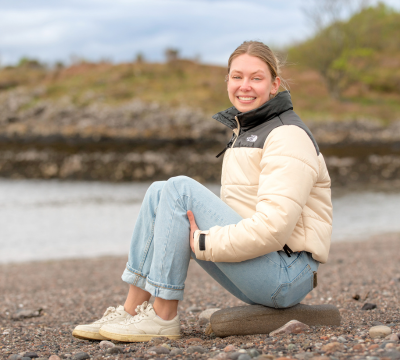
I love this course because our lecturers are renowned scientists in their field, and it's so inspiring to be taught by them. It's hands on with a small number of students per class, so you have a very personal connection to your lecturer.
If you’re passionate about the ocean this is by far the best place study. I think SAMS is brilliant and I would recommend it to anyone especially if you love learning by doing.
Janne is studying on our BSc (Hons) Marine Science with Oceanography and Robotics at SAMS, a UHI partner.
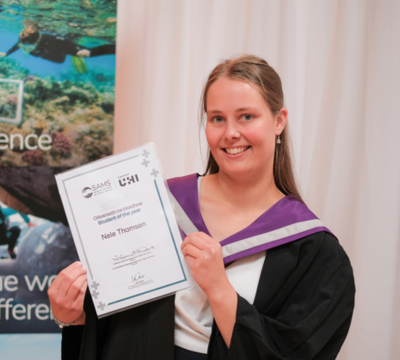
This course offered in-depth training in marine science unlike any other university. I have had a huge freedom to specialise in any area in marine science I wished. This course was diverse and being hosted at a small research institute meant I had the incredible chance to take a variety of opportunities to develop my career.
The support I received during my degree was incredible. Lecturers have always gone above and beyond to help me develop my ideas and create opportunities to grow. I had the opportunity to do an exchange semester in Svalbard during the third year of my degree. I undertook three summer placements in the SAMS labs and once in collaboration with the Norwegian institute Akvaplan-niva during summers to gain more experience in molecular and experimental biology. I also went on a research cruise to the Icelandic Basin with SAMS and NOC for 3 weeks and worked as an onboard chemistry assistant.
I was involved in the diving club and also set up UHI’s first ever student knitting club! UHI all feels like one big community.
Nele studied the BSc (Hons) Marine Science with Arctic Studies at the Scottish Association for Marine Science, a partner of UHI.
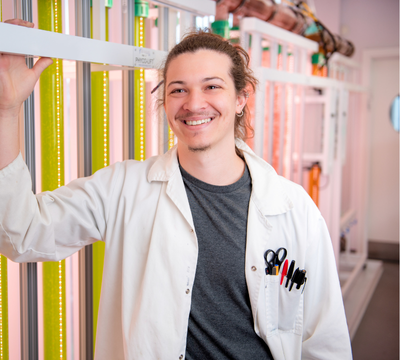
I choose this course mainly for the location, I had a couple other options, but after seeing SAMS, especially how small the university is compared to how large the research centre is, I came here just knowing I would have lots of opportunities to get into the lab, and do lots of research, which is what I want to do. I've had work experience pretty much from the first practical we had, I asked my lecturer if he needed help, and helping with research just snowballed from there. In fact, in my third year, I was really helped by supervisor to develop an assignment I had written into a paper that we eventually published.
I had considered St Andrews and Edinburgh as other options, but it was a no brainer to come to SAMS because of the research opportunities that I knew I would have. SAMS has a small campus, and a select number of students per year, which makes it so much easier to have a dialogue and a repour with your lectures and the researchers.
Alberto studied the BSc (Hons) Marine Science at SAMS, a partner of UHI.
Apply for Marine Science BSc (Hons)
We are delighted that you are thinking about studying at the University of the Highlands and Islands. We operate a fair and open admissions system committed to equality of opportunity and non-discrimination. We consider all applications on merit and on the basis of ability to achieve, without discrimination on grounds of gender, age, disability, ethnicity and socio-economic background. We welcome applications from all prospective students and aim to provide appropriate and efficient services to students with disabilities.