Escape to the Country (Archives): Some Historical Reflections
In this blog, Philippa Woodcock and Juliette Desportes reflect on their use of and engagement with country house archives. The piece follows a recent visit at Brucefield House for the annual meeting of Scottish Association of Country House Archivists (SACHA) in late March 2026, which offered a thought-provoking space to reflect on the central relationship between historical practice and the archives which shape past and present. It also provided an unusual opportunity for an early-modernist and a modern historian to collaborate and exchange ideas with practitioners and owners.
Learn more about the two research projects
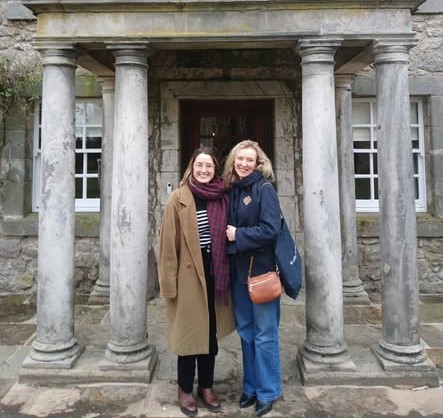
Juliette and Philippa outside Brucefield house in March 2026
Philippa Woodcock: Difficult subjects and the ‘right to do so’
Miscarriage is undoubtedly a difficult subject. Whilst many of us still hesitate to discuss it openly, my RHS-funded research, ‘They Wept Together’, seeks to uncover how families broached the subject in the early modern past, largely through the study of their correspondence. Was miscarriage named euphemistically or explicitly? Did the sex or the religion of the author and recipient influence discourse, and how did families broach the contrast between one couple’s successful childbearing and another’s loss? Most importantly, how did families recover after miscarriage?
Drawing on such information from the past is itself an emotional process but it is important. It may help our contemporary society to form a better understanding of how to help couples after pregnancy loss, whether through the example of writing as a means of therapy, a sense of the care for the mental burden placed on mothers and fathers, and perhaps most importantly, a sense of the time that was recommended for recovery.
Country House Archives have been the ideal repositories for this project. Elite and landed Scottish couples were often compelled by political importance to live apart, overseeing dispersed estates, resident in Edinburgh or at court in London. When miscarriage occurred, it had to be written about. Moreover, miscarriage was significant to the entire estate and extended family, so news spread across a large epistolary network. Nonetheless, I have felt uneasy at times about delving into the sadness experienced by families in the past, and I express my gratitude to all the archivists and estate who have supported my research. It sounds trite but the distress of a bereaved parent does not diminish over the centuries.
Finally, working in the setting of a country house archive does not mean an isolated experience. Yes, these archives are often some of the smallest that a historian might use but for me at least, they have been the site of some of the most collaborative research that I have ever undertaken. Firstly, I have often been reliant on the archivist’s guidance through the catalogue and family trees. Secondly, archives often have volunteers to transcribe materials who have shared their own knowledge of the collections. Finally, everyone I have encountered has an opinion on my project, shaping my ideas: moreover, many have offered up nuggets of their own research to my findings. Users of country house archives may be a small community, but they have been instrumental in the process of co-creation.
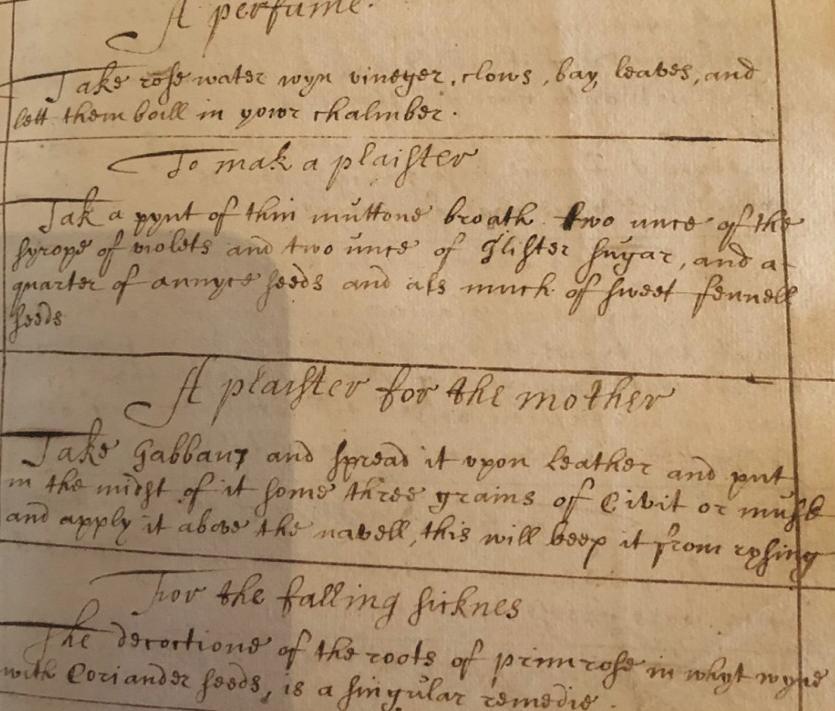
An extract from Lady Helen Middleton’s recipe Book, Glamis Castle. Women were the custodians of medical ‘recipes’ and took great care in detailing pregnancy advice. Courtesy of Strathmore Estates (Holding) Ltd, NRAS 885/ vol. 243
Juliette Desportes: Archival Glimpses; Past Encounters
Estate archives are not only business records, numbers, prices, and wages, but windows into complex worlds filled with people and stories. These stories often constitute mere archival glimpses but are at the heart of the historian’s job whose encounters with the past can then become both personal and emotive.
Take, for instance, this letter noting the passing of Alexander Grant, the author’s father-in-law in April 1789. The paper has been covered with watercolour stains: perhaps the letter was simply used as a blotting paper by its recipient. Combined with the mention of the passing, however, it struck me for its everyday and yet emotive reminder of the presentness of the past and felt worthy of photographing for my own records.
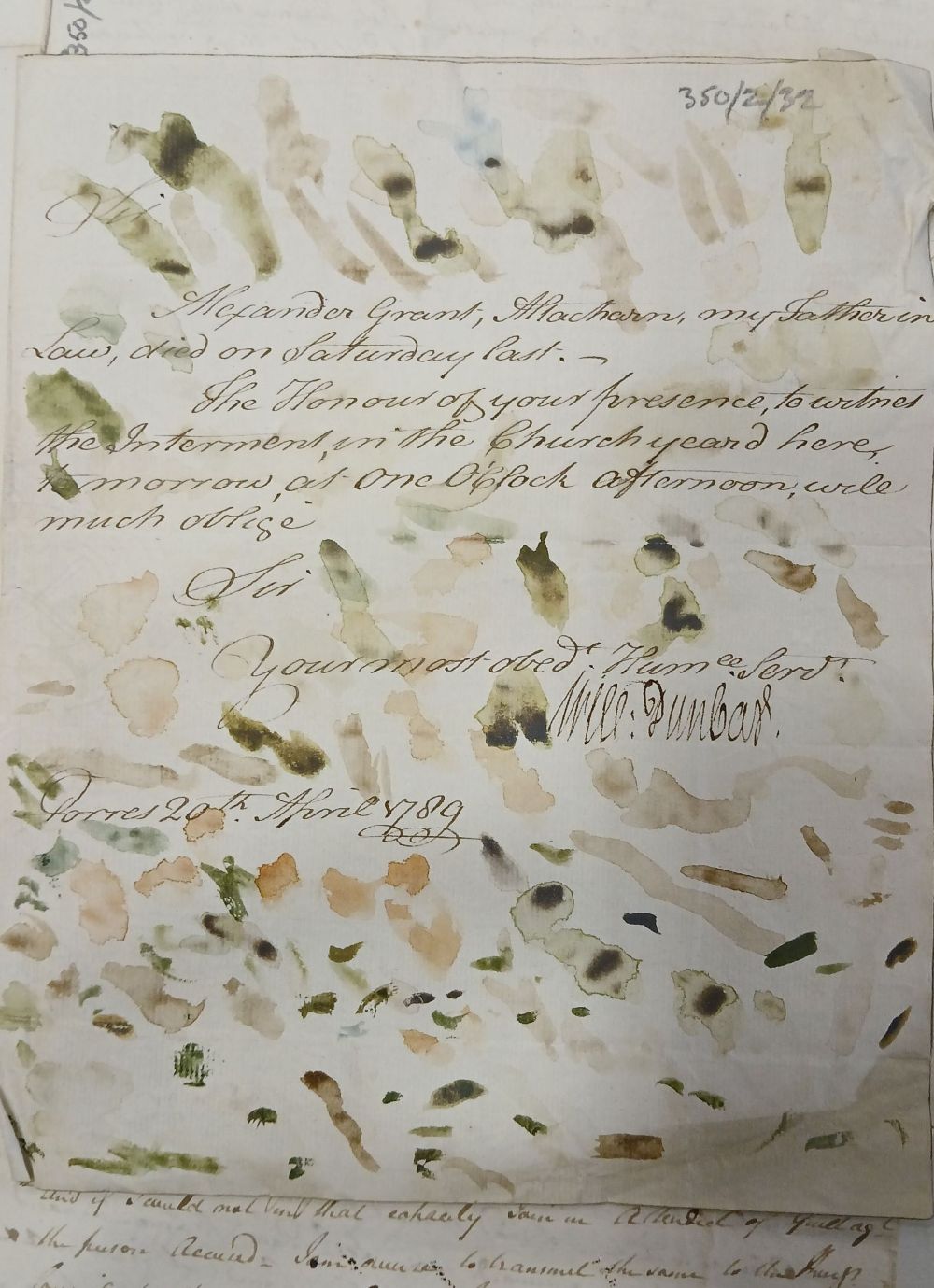
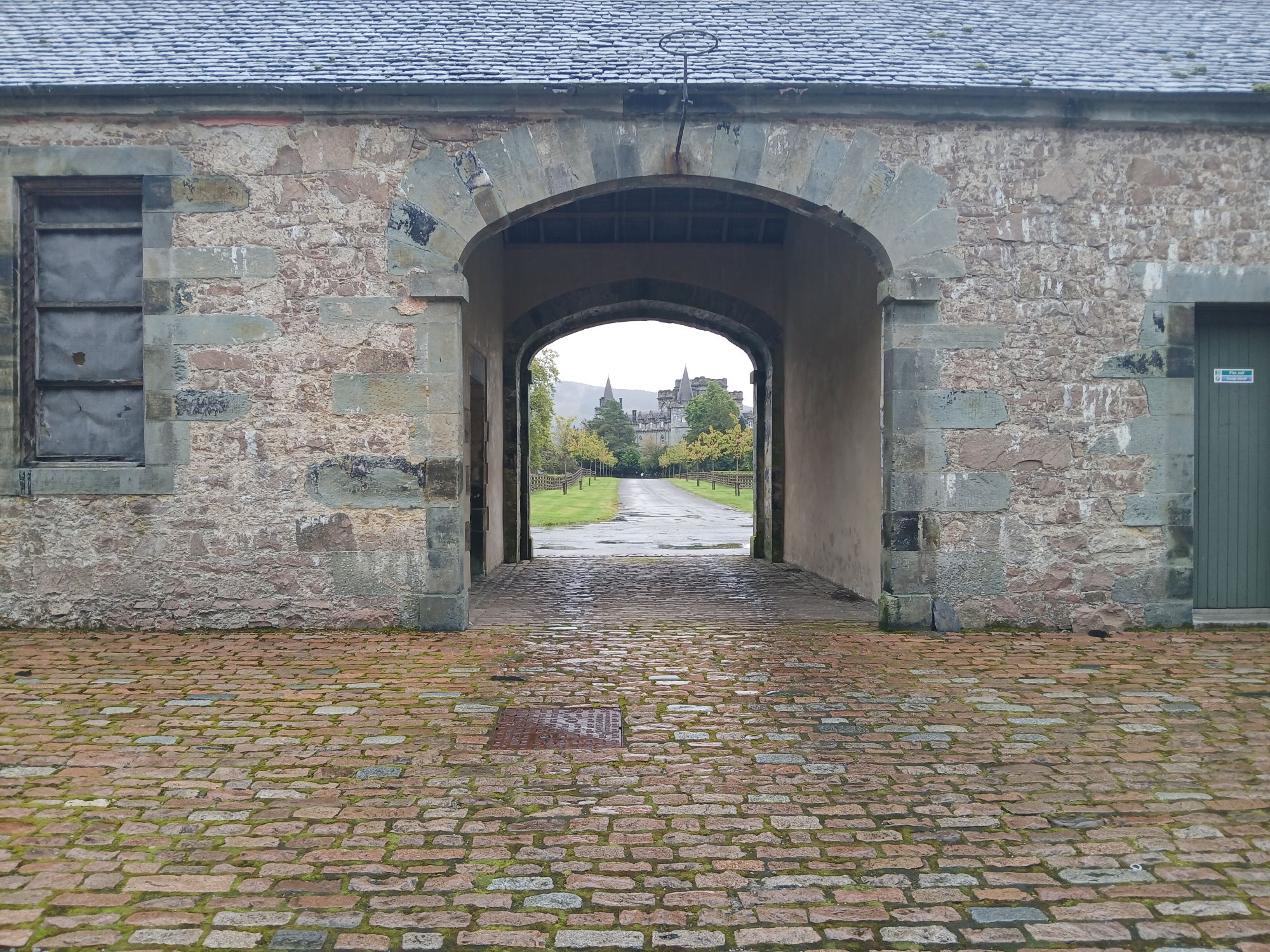 Image above: The fantastic courtyard of Argyll Estate archives, looking towards the castle.
Image on left: A letter notifying the recipient of the death of Alexander Grant, 1789. Courtesy of the National Records of Scotland.
This research, funded by the Leverhulme Trust, delves into estate records to recover the traces and stories of the men and women who lived and laboured on landed estates, the estate personnel, factors and ground officers, as well as legal agents, ministers, and gardeners who all engaged in different ways with agrarian transformation.
Much of the project then is about, as Philippa put it, handling difficult and often emotive stories of loss, although in our case the loss is more often material and centres on evictions, displacement, and poverty. By giving agency to the subjects and objects of agrarian ‘improvement’, the radical changes which dramatically transformed the Scottish countryside through processes such as enclosures and privatisation, the research hopes to make the point that those who lived and worked on these estates did not meekly surrender their lives, their worlds, but resisted and protested to the point past futility.
In turn, writing about everyday resistance and the other array of reactions to these material and, at times, very real human losses, has the potential to make us better understand our contemporary landscapes, and the role land ownership and management plays in our lives, then and now.